

OUR MISSION
At LumeDEL LLC, our mission is to design and deliver unique, high output LED devices that will serve as essential, yet uncomplicated tools for end-users to perform leading edge research in both academic and industrial laboratories.
About LumeDEL
LumeDEL had its genesis when the founders realized that an increasing number of life sciences, medical, scientific, and industrial customers needed the performance of a fiber-coupled LED for their applications but had no idea how to go about it. Their experience and equipment still focused on lasers and mercury arc lamps. They wanted the benefits of an LED source, but in many cases, their needs had outpaced their technical skills.
The company’s multidisciplinary engineering team moved into action. The result is the NewDEL™ portfolio of fiber-coupled LEDs. Featuring dedicated spectral families targeting critical applications like spectroscopy, optogenetics, and fluorescence imaging, NewDEL fiber-coupled LEDs deliver high radiant power in a system that is ready to use out-of-the-box.
The launch of the NewDEL product portfolio is just the start. Other solutions targeting this user base are already in the concept stage.

Our Values
• A focus on innovation
• A dedication to customer success
• A commitment to quality
Latest News
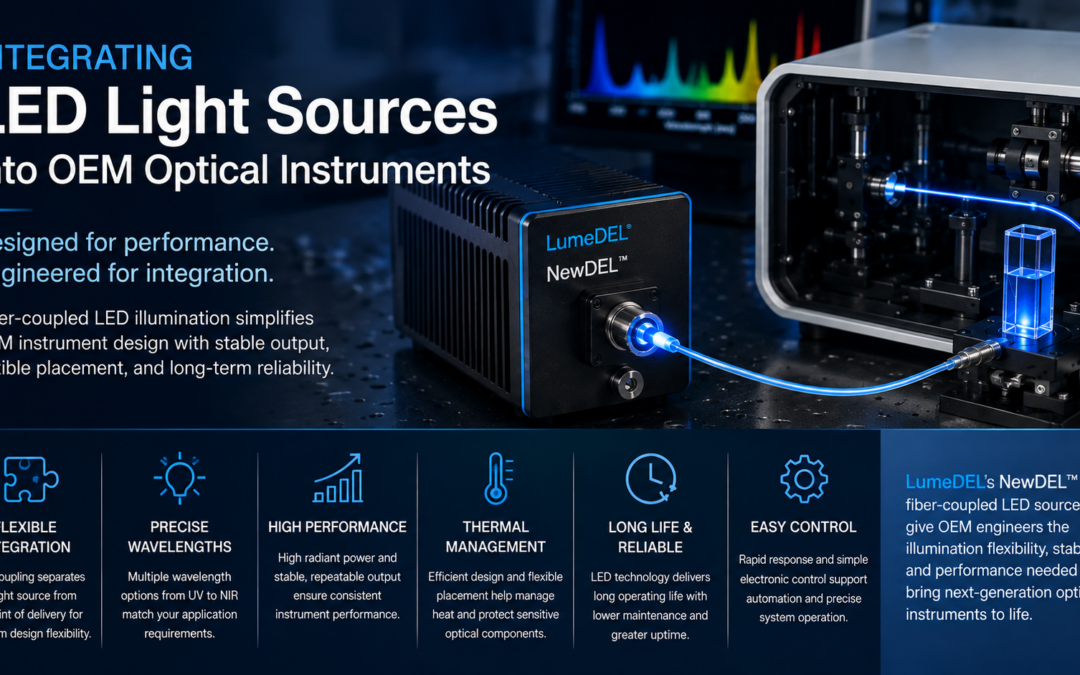
Integrating LED Light Sources into OEM Optical Instruments
Introduction Illumination is a critical component of many OEM optical instruments. Whether a system is designed for spectroscopy, imaging, sensing, medical research, or analytical measurement, the light source must provide the required optical performance while fitting within the physical and operational requirements of the instrument. Modern LED technology offers OEM designers an alternative to traditional lamp-based illumination with advantages that include compact size, long operating life, stable output, precise wavelength selection, and efficient control. Fiber-coupled LED sources provide additional design flexibility by allowing the illumination source to be positioned independently from the point where light is delivered. Start with the Optical Requirements Successful integration begins by defining what the instrument needs from its illumination system. Important optical considerations include: Required wavelength or spectral range Radiant power Output stability Fiber...
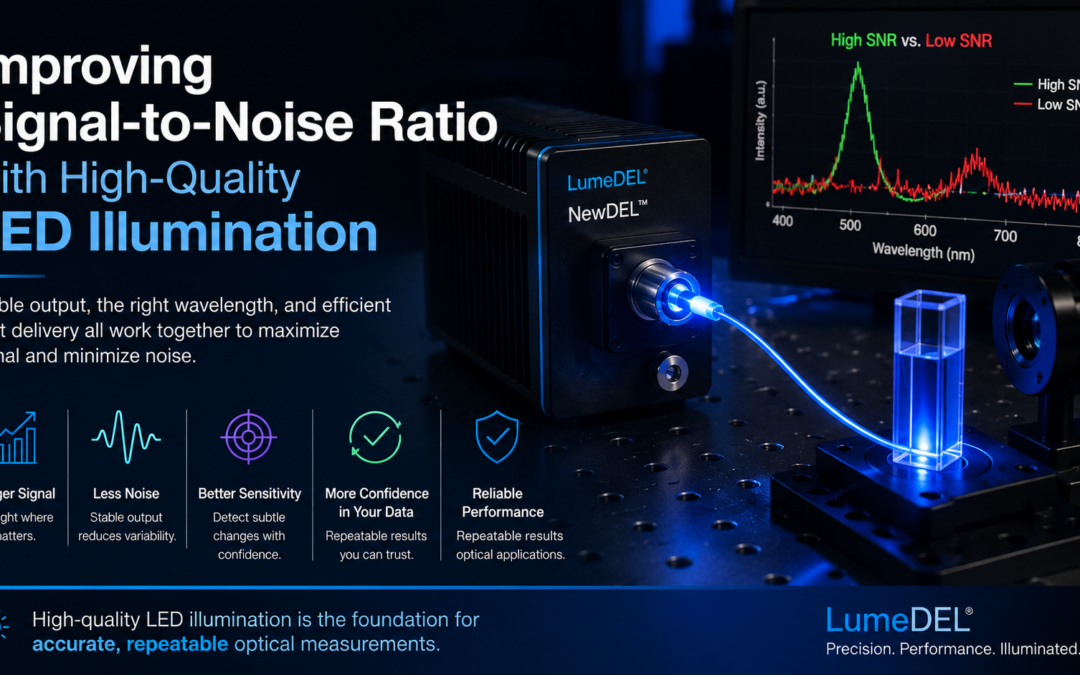
Improving Signal-to-Noise Ratio with High-Quality LED Illumination
Introduction In optical measurement systems, generating a strong signal is only part of the challenge. The ability to distinguish meaningful optical information from background noise is equally important. Signal-to-noise ratio (SNR) is a key measure of performance in spectroscopy, imaging, sensing, and other analytical applications. A higher signal-to-noise ratio can improve measurement sensitivity, increase confidence in collected data, and help optical systems detect smaller changes in a sample. While detectors, electronics, and software all influence SNR, the quality and consistency of the illumination source also play an important role. Stable, efficient LED illumination can help create stronger and more repeatable optical signals while reducing variability introduced by the light source itself. What Is Signal-to-Noise Ratio? Signal-to-noise ratio compares the strength of the desired measurement signal with unwanted background noise. In an optical system, noise can originate from...
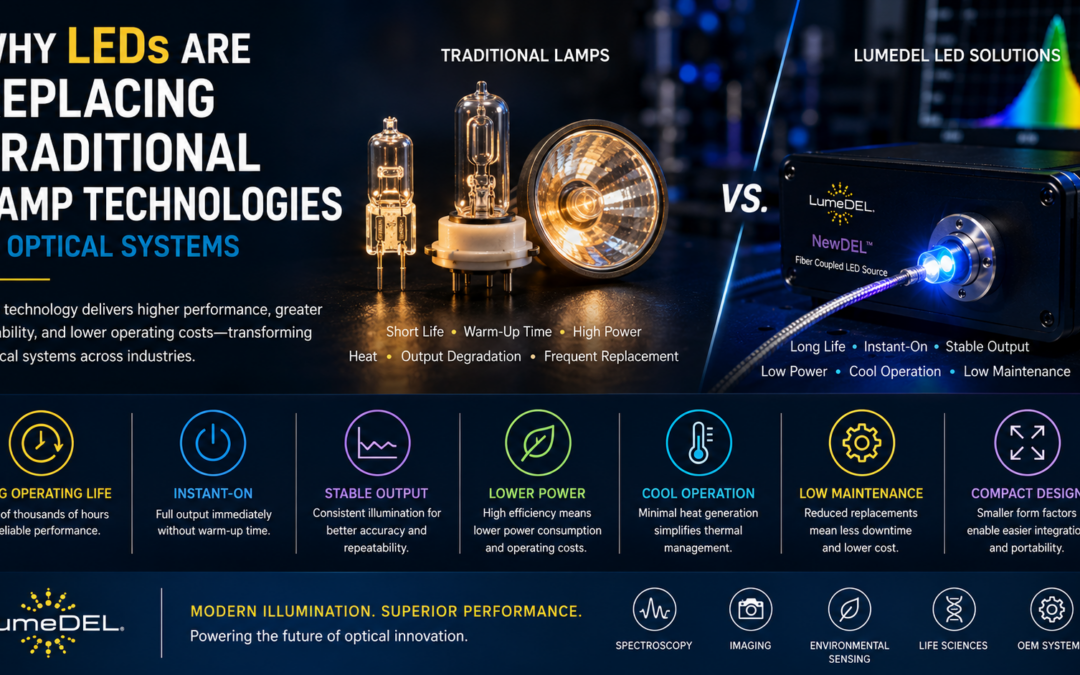
Why LEDs Are Replacing Traditional Lamp Technologies in Optical Systems
Introduction For decades, halogen, xenon, and mercury lamps served as the primary illumination sources for scientific instrumentation and optical analysis. Today, advances in LED technology have transformed the industry, offering higher efficiency, longer operating life, and significantly improved system performance. Modern LED illumination provides engineers and researchers with stable, reliable, and energy-efficient light sources that support spectroscopy, imaging, environmental sensing, and life science research. As optical systems continue to evolve, LEDs have become the preferred choice for both new instrument designs and upgrades to existing equipment. The Limitations of Traditional Lamps While conventional lamps have been widely used, they present several challenges. Common limitations include: Short operating life Warm-up periods Higher power consumption Increased heat generation Output degradation over time Frequent replacement requirements These factors can increase...