

Fluorescence-Guided Surgery
LumeDEL’s NewDEL™ fiber-coupled LEDs provide reliable, high-radiant power illumination at exact wavelengths, making them a powerful choice for spectroscopy across life sciences, medical, and industrial applications.
Fluorescence Guided Surgery
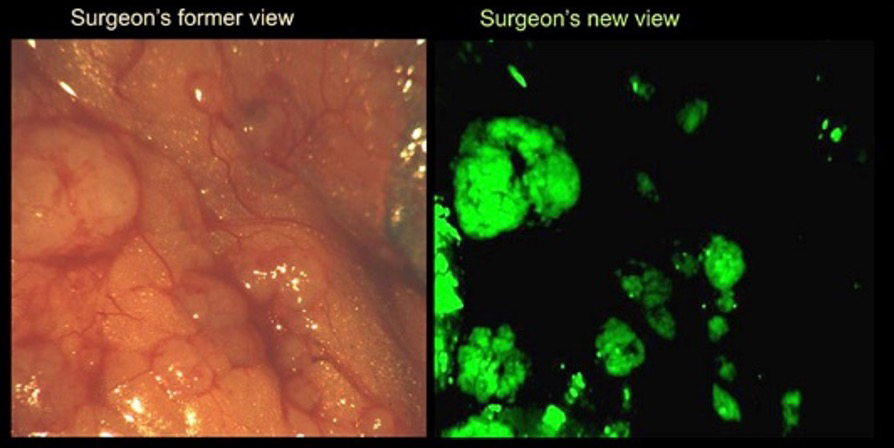
The full removal of malignant cells during cancer surgery dramatically improves patient survival rates but distinguishing cancerous cells from healthy tissue can be extremely challenging. Fluorescence-guided surgery (FGS) gives surgeons a powerful tool for clearly visualizing the margins of a tumor to maximize removal of residual cancer cells. In FGS, specially designed fluorophores preferentially accumulate in tumors. When excited with the appropriate wavelength of light, these materials fluoresce, displaying tumors and other structures in real time with contrasting pseudo-colors. This supports more complete tumor resection and better patient outcomes.
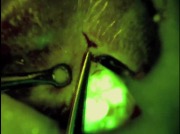
Most FGS fluorophores are excited by monochromatic light in the 650-810 nm spectral range. Those that fluoresce with NIR illumination are particularly effective because the greater penetration depth can reveal subsurface growths. In addition, a few clinically approved dyes are excited by violet (405 nm) and cyan (490 nm) output. Because of the limited penetration depth of short-wavelength light, these materials are typically applied to surface lesions.
Traditionally, fluorescence imaging systems have incorporated lasers, which can be expensive, complex, and often temperamental. The benefits of fiber-coupled LEDs for this application start with robustness – when lives are at stake, systems cannot fail. LEDs are rugged enough to survive the shock and vibration of being moved in the hospital environment. Fiber-coupled LEDs combine high radiant powers, narrowband output, and low cost in a compact form factor. The latter characteristic is particularly important for systems used around the operating table, where space is always at a premium. Their long lifetimes also make them appeal to cost-conscious healthcare organizations.
The NewDEL™ Advantage for FGS:
- Maximum output powers for various diameter fibers
- Fully configurable pulse widths
- Pulse-width-modulated (PWM) dimming for full control over radiant power without wavelength drift
Why LEDs for Fluorescence-Guided Surgery?
Fluorescence-Guided Surgery depends on precise excitation light to highlight tissue structures and improve surgical outcomes. LumeDEL’s NewDEL™ fiber-coupled narrowband LEDs provide stable, high-radiant power illumination at targeted wavelengths, ensuring reliable activation of fluorophores and clear visualization for surgeons and researchers.
Key Benefits of LEDs in FGS
-
- Targeted excitation wavelengths → optimized for fluorophore activation
- Stable output → consistent illumination throughout surgical procedures
- High radiant power → bright, clear fluorescence signals even in challenging environments
- Fiber-coupled precision → directs light accurately into surgical instruments or imaging systems
- Compact, reliable design → easy integration into surgical research platforms
Challenges in Fluorescence-Guided Surgery (and LED Solutions)
Challenge 1: Unstable or drifting light sources
Solution: LumeDEL LEDs provide stable, repeatable output, ensuring consistent fluorescence imaging.
Challenge 2: Bulky, heat-generating systems
Solution: LEDs offer compact, efficient, and cooler-running alternatives.
Challenge 3: Matching fluorophores to light sources
Solution: Narrowband LEDs are available at specific excitation wavelengths to align with common fluorophores.
Applications of LumeDEL LEDs in FGS
-
- Cancer surgery research (tumor margin visualization)
- Vascular and lymphatic imaging
- Preclinical surgical models using fluorescent dyes
- Academic and clinical surgical research programs
Frequently Asked Questions (FAQ)
Why use LEDs for fluorescence-guided surgery instead of lasers?
LEDs deliver stable, narrowband light at the required excitation wavelengths, with less heat and complexity than laser systems.
Which fluorophores are supported by LumeDEL LEDs?
LEDs can be tuned to common visible and NIR fluorophores used in medical research, such as ICG (indocyanine green).
Can fiber-coupled LEDs integrate into surgical imaging systems?
Yes — fiber coupling allows seamless integration into endoscopes, microscopes, and surgical cameras.
Call to Action
Enhance fluorescence-guided imaging with stable, narrowband LED sources. Explore LumeDEL’s recommended models designed for Fluorescence-Guided Surgery.