

optogenetics
LumeDEL’s NewDEL™ fiber-coupled LEDs provide stable, high-radiant power illumination across key wavelengths, delivering precise performance for spectroscopy in life sciences, medical, and industrial research.
Optogenetics
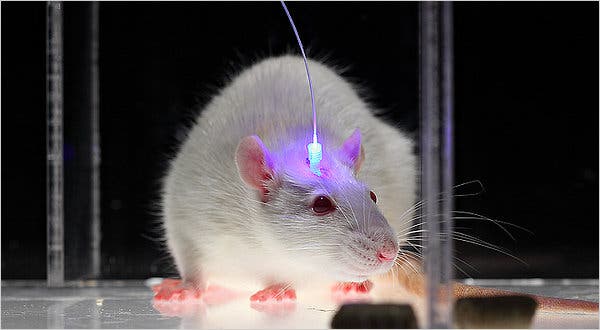
Optogenetics involves using light to control cells and structures that have been genetically modified to incorporate photosensitive proteins. Neurons, cells, or even regions of cells can be activated simply by illuminating them with the proper wavelength. The technique has shown promise for a variety of applications ranging from mapping brain function to controlling stimulation and response. Recent clinical trials in optogenetics are studying its ability to relieve vision loss, deafness, pain, and other conditions. Since the introduction of the technology less than 20 years ago, many top medical journals have described it as a core technology for the future of humanity.
Fiber-coupled LEDs are excellent light sources for optogenetics. They make it possible to study the response of live and freely moving animals to photo stimulation by monochromatic light delivered by optical fiber through implantable cannula.
The NewDEL™ Advantage for Optogenetics:
- User configured triggers and pulse widths to customize operations for the application
- 7 narrowband models, from the deep blue to the red spectral regions for common opsins
Why LEDs for Optogenetics?
Optogenetics relies on precise light delivery at specific wavelengths to activate or inhibit targeted neurons. LumeDEL’s NewDEL™ fiber-coupled narrowband LEDs provide stable, high-radiant power illumination in the blue, green, and red ranges, giving researchers confidence in repeatable and reliable results. Their fiber-coupled design ensures accurate light placement into tissue or optical pathways.
Key Benefits of Narrowband LEDs in Optogenetics
-
- Precise wavelength control → activates specific light-sensitive ion channels
- High radiant power → ensures sufficient light penetration for in-vivo studies
- Stable output → minimizes variability across experiments
- Fiber-coupled design → accurate, localized light delivery into the brain or tissue
- Long operating life → fewer interruptions compared to lasers or lamps
Challenges in Optogenetics (and LED Solutions)
Challenge 1: Maintaining stable, repeatable light levels
Solution: LumeDEL LEDs provide consistent output across long experimental runs.
Challenge 2: Bulky or complex laser setups
Solution: Compact LED sources offer simpler integration with existing rigs.
Challenge 3: Heat generation damaging samples
Solution: LEDs run cooler than many traditional light sources, reducing sample stress.
Applications of LumeDEL LEDs in Optogenetics
-
- Neural circuit mapping and brain activity studies
- Behavioral research in animal models
- Development of new therapies for neurological disorders
- Academic and clinical research in neuroscience
Frequently Asked Questions (FAQ)
Why choose LEDs over lasers for optogenetics?
LEDs are more compact, cost-effective, and stable, with less heat generation and long operating lifespans.
Which wavelengths are most used in optogenetics?
Blue (≈470 nm) for channelrhodopsin activation, green for halorhodopsin, and red for deeper tissue penetration.
Can fiber-coupled LEDs deliver light into living tissue accurately?
Yes — fiber coupling enables targeted light placement for precise experimental control.
Call to Action
Advance your neuroscience research with stable, narrowband LED sources for optogenetics. Explore LumeDEL’s recommended models designed for this application.