

Photocatalysis Research
LumeDEL’s fiber-coupled LEDs provide stable, high-radiant power illumination at targeted wavelengths, supporting advanced photocatalysis research and applications.
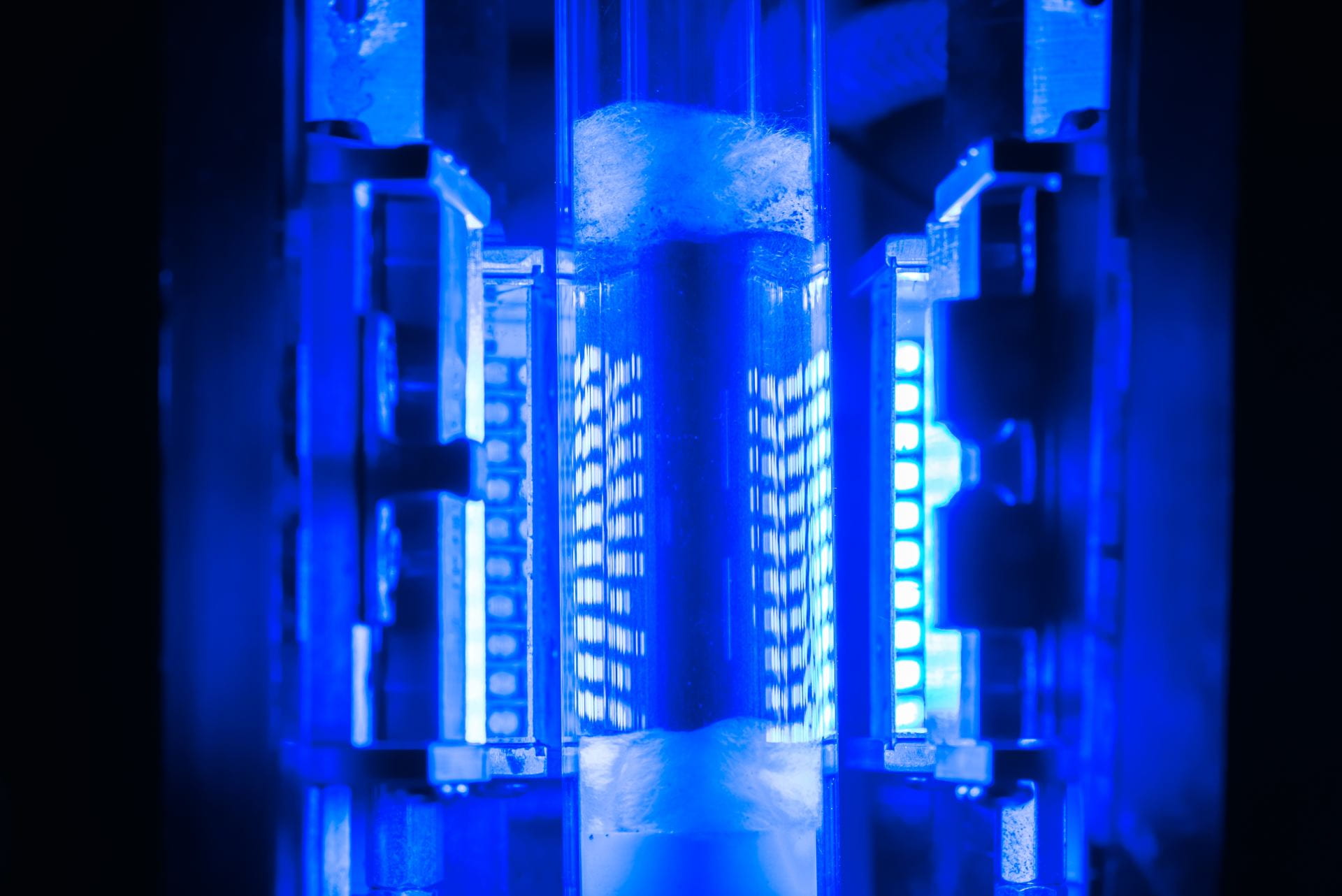
Photocatalysis Research
A photocatalyst is a photoactive material that facilitates a chemical reaction by contributing energy harvested from incident light. Illumination at the proper wavelength puts the photocatalyst into an excited state. It transfers that energy to the precursor elements and molecules so that the reaction occurs faster, or at a lower temperature or pressure. At this point, the photocatalyst relaxes back to steady state, ready for the next cycle.
Photocatalysis has a number of important industrial, life sciences, and scientific applications:
-
Water splitting, a nonpolluting method to produce clean hydrogen for use in hydrogen fuel cells
-
Antibacterial and antiviral fields for air, surface, and water disinfection
-
Cancer treatment, particularly with nano photocatalysts and photo-redox catalysis used to combat hypoxic tumors
-
Synthesis of complex and often highly functionalized molecules for development of new pharmaceuticals and agrochemicals
-
Support of “circular chemistry” in pursuit of a “circular economy” in which there is zero waste
Fiber-coupled LEDs provide ideal light sources for the research and product development environment. They’re compact, efficient, and provide narrowband spectral coverage ranging from the UV-A spectral region throughout visible wavelengths (365-600 nm).
The NewDEL™ Advantage for Photocatalysis Research:
- Programmable and highly configurable for a system that can support a variety of experiments
- High radiant power
- Stable spectral output for repeatable results
Why LEDs for Photocatalysis Research?
Photocatalysis relies on precise light wavelengths to activate catalysts that drive chemical reactions. LumeDEL’s NewDEL™ fiber-coupled LEDs provide stable, high-radiant power illumination in UV and visible ranges, ensuring accurate, repeatable results for photocatalytic studies. Their long-life design and fiber-coupled delivery make them a reliable and efficient alternative to traditional lamp systems.
Key Benefits of LEDs in Photocatalysis
-
- Targeted excitation wavelengths → optimized for activating common photocatalysts like TiO₂
- Stable spectral output → ensures reproducibility in experimental results
- High radiant power → supports both fundamental research and scaled-up testing
- Fiber-coupled precision → delivers light efficiently into reaction chambers
- Compact and durable → long operating life compared to fragile arc or mercury lamps
Challenges in Photocatalysis (and LED Solutions)
Challenge 1: Instability from traditional lamps
Solution: LEDs provide steady, reliable output for controlled experiments.
Challenge 2: Broad, uncontrolled spectral emission
Solution: Narrowband LEDs deliver light matched to specific catalyst absorption peaks.
Challenge 3: Frequent lamp replacement and downtime
Solution: Solid-state LEDs last thousands of hours, minimizing maintenance.
Applications of LumeDEL LEDs in Photocatalysis Research
-
- Environmental remediation (air and water purification)
- Hydrogen production through photocatalytic water splitting
- CO₂ reduction and sustainable energy research
- Development of advanced photocatalytic materials
- Academic and industrial research programs
Frequently Asked Questions (FAQ)
Why use LEDs instead of traditional lamps in photocatalysis?
LEDs provide narrowband light at catalyst-specific wavelengths, reduce variability, and operate longer without replacement.
Which wavelengths are most used for photocatalysis?
UV (especially around 365 nm) for TiO₂ and other catalysts, as well as visible light for emerging photocatalysts.
Can fiber-coupled LEDs integrate into photocatalytic reactors?
Yes — fiber coupling enables precise light delivery into test chambers and scalable systems.
Call to Action
Drive innovation in photocatalysis with stable, high-performance LED sources. Explore LumeDEL’s recommended models designed for Photocatalysis Research.