
Photocuring and Photopolymerization
LumeDEL’s fiber-coupled LEDs deliver stable, high-radiant power light at key wavelengths, making them ideal for precise photocuring and photopolymerization in research and manufacturing.
Photocuring/Photopolymerization
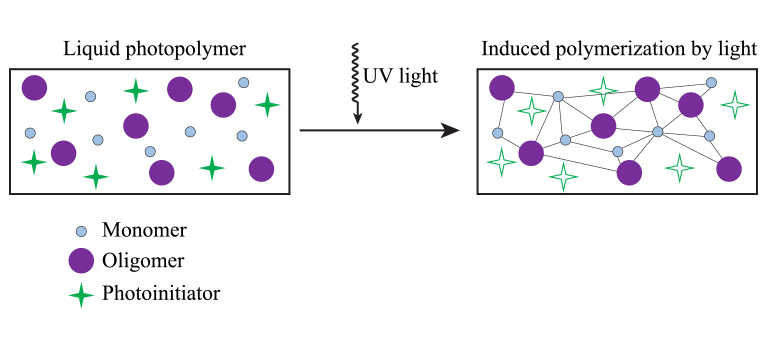
A photopolymer or light-activated resin is a polymer that changes its properties when exposed to light, often in the ultraviolet or visible (blue) spectrum. A liquid or gel monomer is converted/cured into a solid polymer. Photopolymerization chemistry is commercially utilized in a wide variety of applications such as printing, coatings, adhesives, sealants, printed circuit boards, lithography and more recently 3D printing. UV spot curing is typically performed through fiberoptic light delivery.
The NewDEL™ Advantage for
Photocuring/Photopolymerization
- High radiant power and pulsed modes of operation
- Easy control of parameters like pulse width
Why LEDs for Photocuring and Photopolymerization?
Photocuring and photopolymerization rely on controlled UV and visible light to initiate chemical reactions that harden or crosslink materials. LumeDEL’s NewDEL™ fiber-coupled LEDs provide stable, high-radiant power illumination at targeted wavelengths, ensuring reliable curing results in research and industrial settings. Unlike traditional lamp systems, LEDs offer precise wavelength control, longer life, and improved efficiency.
Key Benefits of LEDs in Photocuring / Photopolymerization
-
- Targeted wavelengths → optimized for photoinitiators used in curing processes
- Stable light output → ensures consistent curing results batch after batch
- High radiant power → accelerates curing time and increases throughput
- Fiber-coupled precision → delivers light exactly where needed in experimental setups
- Compact, long-life design → lower maintenance compared to mercury or arc lamps
Challenges in Photocuring (and LED Solutions)
Challenge 1: Inconsistent curing due to lamp drift
Solution: LEDs provide stable, repeatable output with no warm-up time.
Challenge 2: Broad or uncontrolled spectral emission
Solution: Narrowband LEDs deliver light tuned to match specific photoinitiators.
Challenge 3: Heat generation damaging materials
Solution: LEDs generate less heat, reducing stress on sensitive samples.
Applications of LumeDEL LEDs in Photocuring / Photopolymerization
-
- Dental materials and adhesives
- 3D printing and additive manufacturing
- Coatings, inks, and thin films
- Research on novel polymers and composites
- Academic and industrial R&D labs
Frequently Asked Questions (FAQ)
Why use LEDs instead of traditional UV lamps for curing?
LEDs deliver consistent, narrowband output, last longer, and avoid the hazards of mercury-based lamps.
Which wavelengths are commonly used for photopolymerization?
UV and visible wavelengths are selected to match the absorption peaks of specific photoinitiators.
Can fiber-coupled LEDs be integrated into curing systems?
Yes — fiber coupling allows precise, efficient delivery of curing light into lab or industrial setups.
Call to Action
Improve curing consistency and efficiency with stable, narrowband LED sources. Explore LumeDEL’s recommended models designed for Photocuring and Photopolymerization.