

Photodynamic Therapy (PDT)
LumeDEL’s fiber-coupled LEDs deliver controlled, stable light at precise wavelengths, supporting advanced Photodynamic Therapy research and treatment.
Photodynamic Therapy (PDT)
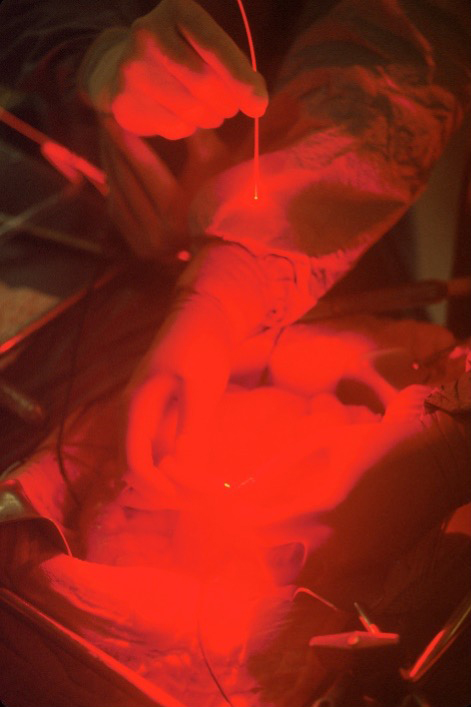
In PDT, light activates a drug that preferentially concentrates in tumor tissue, triggering a photochemical reaction that kills the cancer cells. The drugs are either delivered by infusion or applied topically. Because the process needs to occur in the presence of oxygen, initial investigations focused on skin cancers. Endoscopy and fiber-coupled light sources have enabled the technique to be applied to tumors of the throat, esophagus, airways, lungs, and even internal tissues.
The output characteristics of the light source are critical to success. Each PDT drug has a specific activation waveband. Because the penetration depth of light in tissue goes as a function of wavelength, the excitation wavelength also can be selected to target different layers – blue light for surface lesions and red/NIR light for subsurface growths. Destroying tumor cells while leaving healthy tissue undamaged is a balancing act that requires variable radiant power, so sources must have well behaved dimming characteristics.
The NewDEL™ Advantage for PDT:
- Broad choice of narrowband sources
- Pulse-width-modulated (PWM) dimming for full control over radiant power without wavelength drift
Why LEDs for Photodynamic Therapy (PDT)?
Photodynamic Therapy depends on controlled light at specific wavelengths to activate photosensitizers and destroy targeted cells. LumeDEL’s NewDEL™ fiber-coupled narrowband LEDs deliver stable, high-radiant power red and near-infrared light, ensuring accurate dosing and reproducible results in both research and clinical settings.
Key Benefits of LEDs in PDT
-
- Targeted wavelengths → red and NIR output matched to photosensitizer absorption peaks
- Stable light delivery → consistent illumination improves treatment accuracy
- High radiant power → ensures effective activation while minimizing treatment time
- Fiber-coupled precision → directs light exactly where it’s needed
- Compact and reliable → long-life LEDs reduce maintenance compared to lasers
Challenges in Photodynamic Therapy (and LED Solutions)
Challenge 1: Inconsistent illumination from older light sources
Solution: LumeDEL LEDs provide stable, repeatable output for controlled treatments.
Challenge 2: Bulky, expensive laser systems
Solution: Compact LED systems are easier to integrate and maintain.
Challenge 3: Matching photosensitizers with light sources
Solution: Narrowband LEDs are tuned to align with common PDT drugs.
Applications of LumeDEL LEDs in PDT
-
- Cancer treatment research using photosensitizers
- Antimicrobial therapies for skin and surface infections
- Ophthalmic treatments (age-related macular degeneration, ocular tumors)
- Clinical and preclinical research in medical photonics
Frequently Asked Questions (FAQ)
Why use LEDs instead of lasers for PDT?
LEDs provide stable, narrowband light at the right wavelengths, with less heat and lower cost than lasers.
What wavelengths are commonly used in PDT?
Red (around 630–690 nm) and near-infrared light, chosen to match specific photosensitizers.
Can fiber-coupled LEDs target small or localized treatment areas?
Yes — fiber coupling allows precise delivery into tissue or treatment sites.
Call to Action
Support advanced PDT research with stable, narrowband LEDs tuned for photosensitizer activation. Explore LumeDEL’s recommended models designed for Photodynamic Therapy.