
Introduction In many optical and analytical applications, illumination quality is measured not only by wavelength and radiant power but also by long-term stability and repeatability. Even minor fluctuations in light output can affect measurement accuracy, reduce...
High Radiant Power LEDs: Why Output Matters in Optical Systems
Introduction In optical systems, illumination quality is often judged by wavelength and stability. However, radiant power—the amount of optical energy delivered to a target—plays an equally critical role in determining system performance. High radiant power LEDs are...
Fiberoptic Patch Cords and Accessories: Ensuring Efficient Light Delivery
Introduction In fiber-coupled optical systems, the performance of the light source is only part of the equation. The efficiency and reliability of light delivery depend heavily on the quality of the fiberoptic patch cords and accessories used within the system....
Understanding Fiber-Coupled LED Sources: Performance, Stability, and Integration
Introduction Fiber-coupled LED sources have become a preferred illumination solution for spectroscopy, imaging, sensing, and analytical instrumentation. By combining the efficiency and stability of modern LEDs with precision optical fiber delivery, these systems...
Broadband vs Narrowband LED Sources: Choosing the Right Illumination Strategy
Introduction Selecting the appropriate LED illumination source requires more than simply choosing a wavelength. In many optical systems, the choice between broadband LED sources and narrowband LED sources significantly affects measurement accuracy, signal quality, and...
LED Illumination for Environmental Sensing and Monitoring
Introduction Environmental sensing and monitoring play a critical role in understanding air quality, water safety, climate conditions, and industrial emissions. From laboratory analysis to field-deployed instruments, accurate optical measurements are essential for...
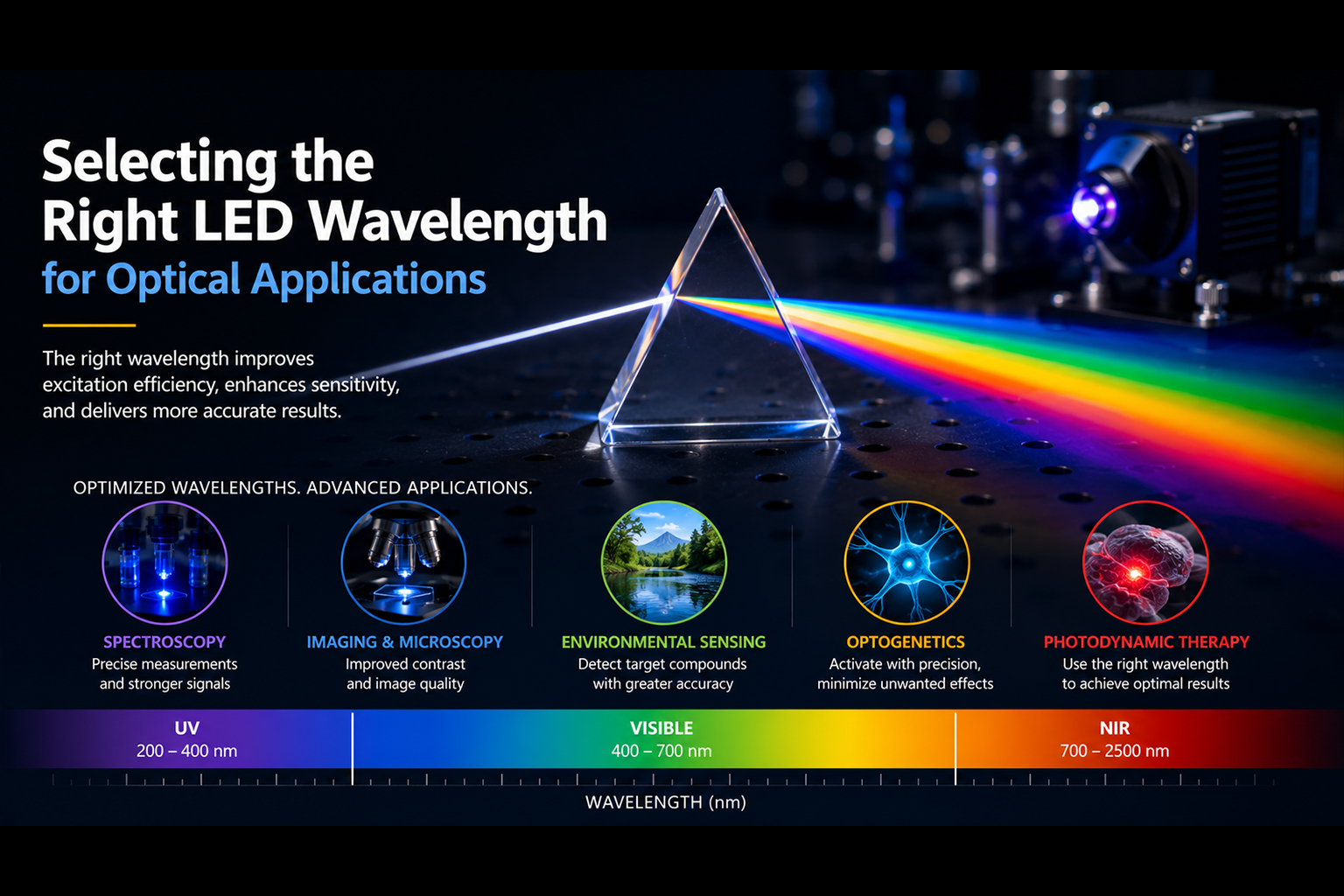
Selecting the Right LED Wavelength for Optical Applications
Choosing the correct LED wavelength is one of the most important decisions when designing optical and analytical systems. The wavelength of the illumination source directly affects signal strength, measurement accuracy, excitation efficiency, and overall system performance.
Different applications require different portions of the electromagnetic spectrum. From ultraviolet and visible wavelengths to near-infrared illumination, selecting the appropriate LED wavelength helps researchers and engineers optimize spectroscopy, imaging, sensing, and fluorescence-based measurements.
Understanding how wavelength influences optical performance is essential for achieving reliable and repeatable results.
Why Wavelength Selection Matters
Every material interacts with light differently. Certain molecules absorb or emit light more effectively at specific wavelengths, making wavelength selection a critical factor in system design.
Proper wavelength selection can improve:
- Signal-to-noise ratio
- Measurement sensitivity
- Excitation efficiency
- Image contrast
- Detection accuracy
Selecting an inappropriate wavelength may reduce system performance and limit the quality of experimental results.
Ultraviolet (UV) LED Applications
Ultraviolet wavelengths are commonly used in applications that require high-energy excitation or enhanced sensitivity.
Common uses include:
- Fluorescence excitation
- Chemical and biological analysis
- Forensic inspection
- Environmental monitoring
- Photodynamic therapy research
UV LED sources provide long operational life and improved stability compared with traditional mercury lamps.
Visible LED Applications
Visible wavelengths support a wide variety of scientific and industrial applications.
Typical applications include:
- Spectroscopy
- Machine vision
- Color analysis
- Microscopy
- General optical testing
Visible LEDs offer excellent efficiency, stability, and flexibility while supporting both broadband and narrowband illumination strategies.
Near-Infrared (NIR) LED Applications
Near-infrared wavelengths are widely used when visible light is unsuitable or when deeper penetration into materials is required.
Common applications include:
- Biomedical imaging
- Optical sensing
- Material analysis
- Agricultural monitoring
- Industrial inspection
Near-infrared LEDs enable non-destructive measurements and improved sensing capabilities in many advanced systems.
Matching Wavelength to the Application
The optimal wavelength depends on the interaction between light and the sample being studied.
Spectroscopy
Different chemical compounds absorb light at specific wavelengths. Selecting the proper wavelength improves sensitivity and measurement precision.
Fluorescence Imaging
Excitation wavelengths must align with the absorption characteristics of the fluorophore to maximize emission intensity.
Environmental Monitoring
Target gases and compounds often exhibit distinct spectral signatures, making wavelength selection critical for accurate detection.
Optogenetics
Precise wavelengths are required to activate light-sensitive proteins while minimizing unwanted effects.
Photodynamic Therapy
Specific wavelengths are necessary to activate photosensitive compounds used in therapeutic applications.
Broadband vs Narrowband Considerations
Wavelength selection also depends on whether the application requires broadband or narrowband illumination.
Broadband LED Sources
Broadband illumination provides wider spectral coverage and is well suited for:
- Reflectance measurements
- General spectroscopy
- Calibration applications
- Multi-wavelength analysis
Narrowband LED Sources
Narrowband illumination delivers highly targeted wavelengths for:
- Fluorescence excitation
- Chemical analysis
- Selective sensing
- High signal-to-noise measurements
Understanding these differences helps engineers optimize both wavelength and illumination strategy.
Why LEDs Offer Greater Flexibility
Modern LED technology provides several advantages when selecting wavelengths:
- Precise spectral control
- Long operational lifetime
- Stable output
- Instant on/off capability
- Efficient thermal management
- Compact integration options
These characteristics make LEDs an ideal solution for optical instrumentation and research applications.
LumeDEL Fiber-Coupled LED Solutions
LumeDEL’s NewDEL™ fiber-coupled LED sources are available in a wide range of wavelengths and configurations to support demanding optical applications.
Key advantages include:
- Precise wavelength selection
- High radiant power
- Stable output with minimal drift
- Efficient fiber-coupled delivery
- Flexible OEM integration
These systems help researchers and instrument designers optimize performance across spectroscopy, imaging, environmental sensing, and biomedical applications.
Conclusion
Selecting the proper LED wavelength is fundamental to achieving accurate and reliable optical measurements. Whether working in ultraviolet, visible, or near-infrared regions, matching wavelength to the application improves sensitivity, image quality, and overall system performance.
By combining precise wavelength control with stable fiber-coupled illumination, modern LED systems provide the flexibility and performance required for today’s most advanced optical and analytical applications.