
Introduction Illumination is a critical component of many OEM optical instruments. Whether a system is designed for spectroscopy, imaging, sensing, medical research, or analytical measurement, the light source must provide the required optical performance while...
Improving Signal-to-Noise Ratio with High-Quality LED Illumination
Introduction In optical measurement systems, generating a strong signal is only part of the challenge. The ability to distinguish meaningful optical information from background noise is equally important. Signal-to-noise ratio (SNR) is a key measure of performance in...
Why LEDs Are Replacing Traditional Lamp Technologies in Optical Systems
Introduction For decades, halogen, xenon, and mercury lamps served as the primary illumination sources for scientific instrumentation and optical analysis. Today, advances in LED technology have transformed the industry, offering higher efficiency, longer operating...
How to Choose the Right Fiber-Coupled LED Source for Your Application
Introduction Selecting the right fiber-coupled LED source is one of the most important decisions when designing an optical system. The ideal illumination solution depends on several factors, including wavelength, radiant power, fiber compatibility, stability, and the...
Selecting the Right LED Wavelength for Optical Applications
Choosing the correct LED wavelength is one of the most important decisions when designing optical and analytical systems. The wavelength of the illumination source directly affects signal strength, measurement accuracy, excitation efficiency, and overall system...
High Radiant Power LEDs: Why Output Matters in Optical Systems
Introduction In optical systems, illumination quality is often judged by wavelength and stability. However, radiant power—the amount of optical energy delivered to a target—plays an equally critical role in determining system performance. High radiant power LEDs are...
LED Stability and Repeatability: Why Consistent Output Matters
Introduction
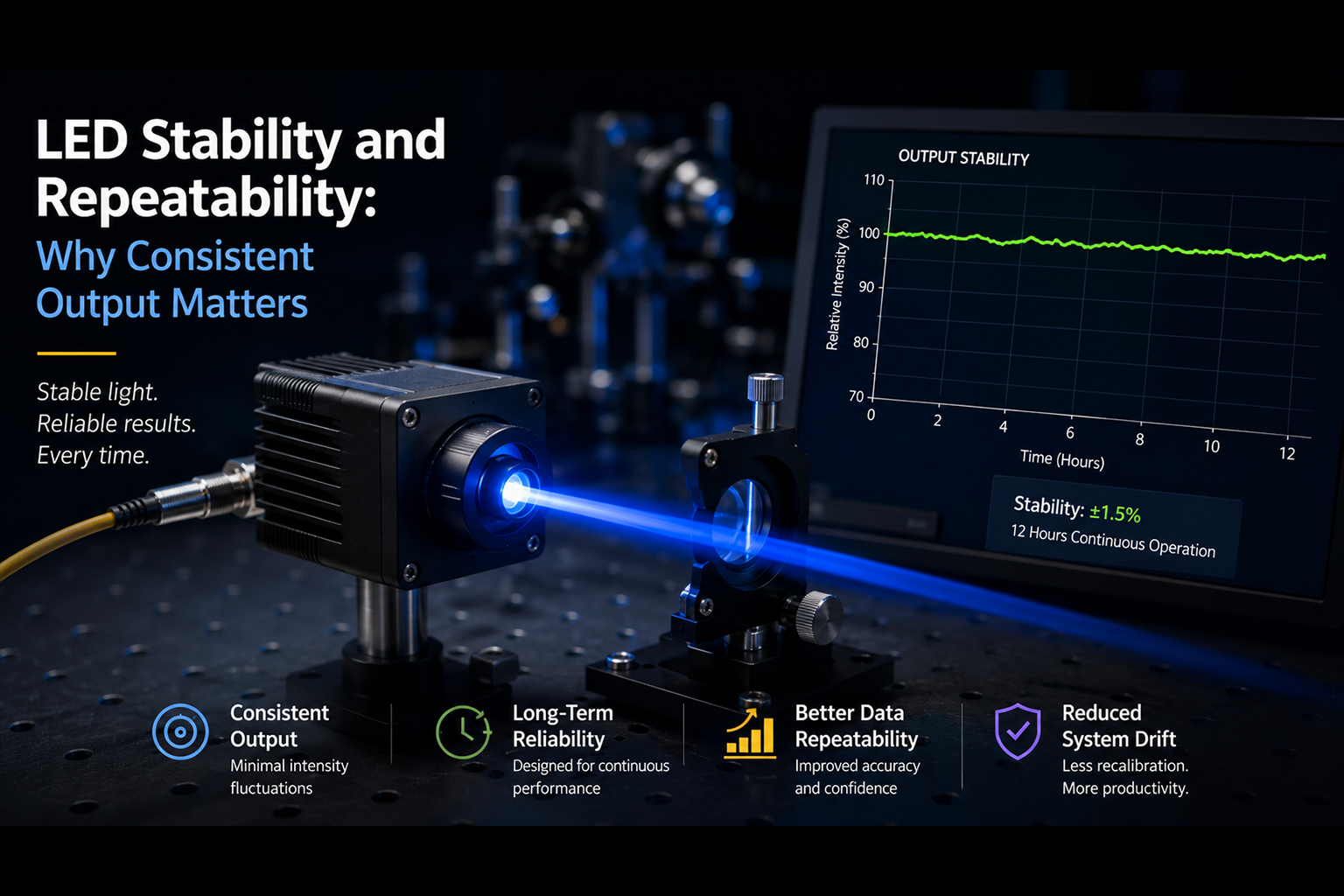
In many optical and analytical applications, illumination quality is measured not only by wavelength and radiant power but also by long-term stability and repeatability. Even minor fluctuations in light output can affect measurement accuracy, reduce signal quality, and introduce inconsistencies between tests.
For spectroscopy, fluorescence imaging, environmental sensing, and OEM instrumentation, stable illumination is essential for obtaining reliable and reproducible results. Modern LED technology has become the preferred solution because it delivers highly consistent output over extended operating periods while minimizing the drift commonly associated with traditional lamp-based sources.
Understanding the importance of LED stability helps engineers and researchers optimize system performance and improve confidence in their data.
What Are Stability and Repeatability?
Stability refers to the ability of a light source to maintain consistent output over time.
Repeatability refers to the ability to reproduce the same illumination conditions from one measurement or experiment to the next.
Together, these characteristics ensure that optical systems generate reliable and comparable results, even during long-term operation.
Why Consistent Output Matters
- Improved Measurement Accuracy
In spectroscopy and sensing applications, changes in illumination intensity can influence signal strength and introduce measurement errors. Stable LED output helps maintain consistent conditions, improving overall accuracy.
This is especially important in:
- Absorption spectroscopy
- Fluorescence analysis
- Environmental monitoring
- Chemical and biological sensing
- Enhanced Data Repeatability
Researchers often need to compare measurements taken over hours, days, or even months. Repeatable illumination ensures that changes observed in the data reflect the sample being measured rather than variations in the light source itself.
Reliable repeatability improves confidence in:
- Experimental results
- Calibration procedures
- Long-term trend analysis
- Quality control processes
- Reduced System Drift
Traditional light sources can experience intensity fluctuations and gradual degradation over time. Modern LED sources provide exceptional stability with minimal drift, helping maintain consistent system performance throughout extended operating periods.
Reduced drift leads to:
- Fewer recalibration requirements
- Improved consistency
- Lower maintenance demands
- Greater operational efficiency
- Better Performance in Fiber-Coupled Systems
Fiber-coupled LED systems depend on consistent optical output to maximize transmission efficiency and maintain repeatable illumination geometry.
Stable output benefits:
- Spectroscopy systems
- Imaging platforms
- Environmental sensing instruments
- OEM optical devices
When combined with precision fiber delivery, stable LEDs provide highly reliable illumination for demanding applications.
Applications That Depend on Stable LED Illumination
Spectroscopy
Accurate spectral measurements require consistent illumination conditions to ensure reliable absorption and emission analysis.
Fluorescence Imaging
Stable excitation sources improve image quality and reduce variability during long-duration experiments and time-lapse imaging.
Environmental Monitoring
Continuous sensing systems rely on repeatable illumination to detect subtle changes in chemical or biological samples.
OEM Instrumentation
Manufacturers of optical instruments require illumination systems that maintain performance throughout the life of the device.
Why LEDs Outperform Traditional Light Sources
Compared with halogen, xenon, and mercury lamps, LED sources offer several advantages:
- Minimal output drift
- Long operational lifetime
- Instant on/off operation
- Lower power consumption
- Reduced maintenance requirements
These characteristics make LEDs well suited for applications where repeatability and reliability are critical.
LumeDEL Fiber-Coupled LED Solutions
LumeDEL’s NewDEL™ fiber-coupled LED sources are designed to provide exceptional output stability and repeatability across a wide range of optical applications.
Key advantages include:
- Stable illumination over extended operating periods
- Efficient fiber-coupled light delivery
- High radiant power with minimal drift
- Precise wavelength selection
- Compact, integration-friendly design
These features help researchers and OEM manufacturers achieve accurate, repeatable results while reducing system maintenance and calibration requirements.
Conclusion
In precision optical systems, consistent illumination is just as important as wavelength and radiant power. Stability and repeatability directly influence measurement accuracy, signal quality, and long-term system performance.
By delivering highly stable output with minimal drift, modern LED sources enable more reliable spectroscopy, imaging, sensing, and analytical measurements. LumeDEL’s fiber-coupled LED solutions provide the consistency and performance required for today’s most demanding optical applications.