
Introduction Illumination is a critical component of many OEM optical instruments. Whether a system is designed for spectroscopy, imaging, sensing, medical research, or analytical measurement, the light source must provide the required optical performance while...
Why LEDs Are Replacing Traditional Lamp Technologies in Optical Systems
Introduction For decades, halogen, xenon, and mercury lamps served as the primary illumination sources for scientific instrumentation and optical analysis. Today, advances in LED technology have transformed the industry, offering higher efficiency, longer operating...
How to Choose the Right Fiber-Coupled LED Source for Your Application
Introduction Selecting the right fiber-coupled LED source is one of the most important decisions when designing an optical system. The ideal illumination solution depends on several factors, including wavelength, radiant power, fiber compatibility, stability, and the...
Selecting the Right LED Wavelength for Optical Applications
Choosing the correct LED wavelength is one of the most important decisions when designing optical and analytical systems. The wavelength of the illumination source directly affects signal strength, measurement accuracy, excitation efficiency, and overall system...
LED Stability and Repeatability: Why Consistent Output Matters
Introduction In many optical and analytical applications, illumination quality is measured not only by wavelength and radiant power but also by long-term stability and repeatability. Even minor fluctuations in light output can affect measurement accuracy, reduce...
High Radiant Power LEDs: Why Output Matters in Optical Systems
Introduction In optical systems, illumination quality is often judged by wavelength and stability. However, radiant power—the amount of optical energy delivered to a target—plays an equally critical role in determining system performance. High radiant power LEDs are...
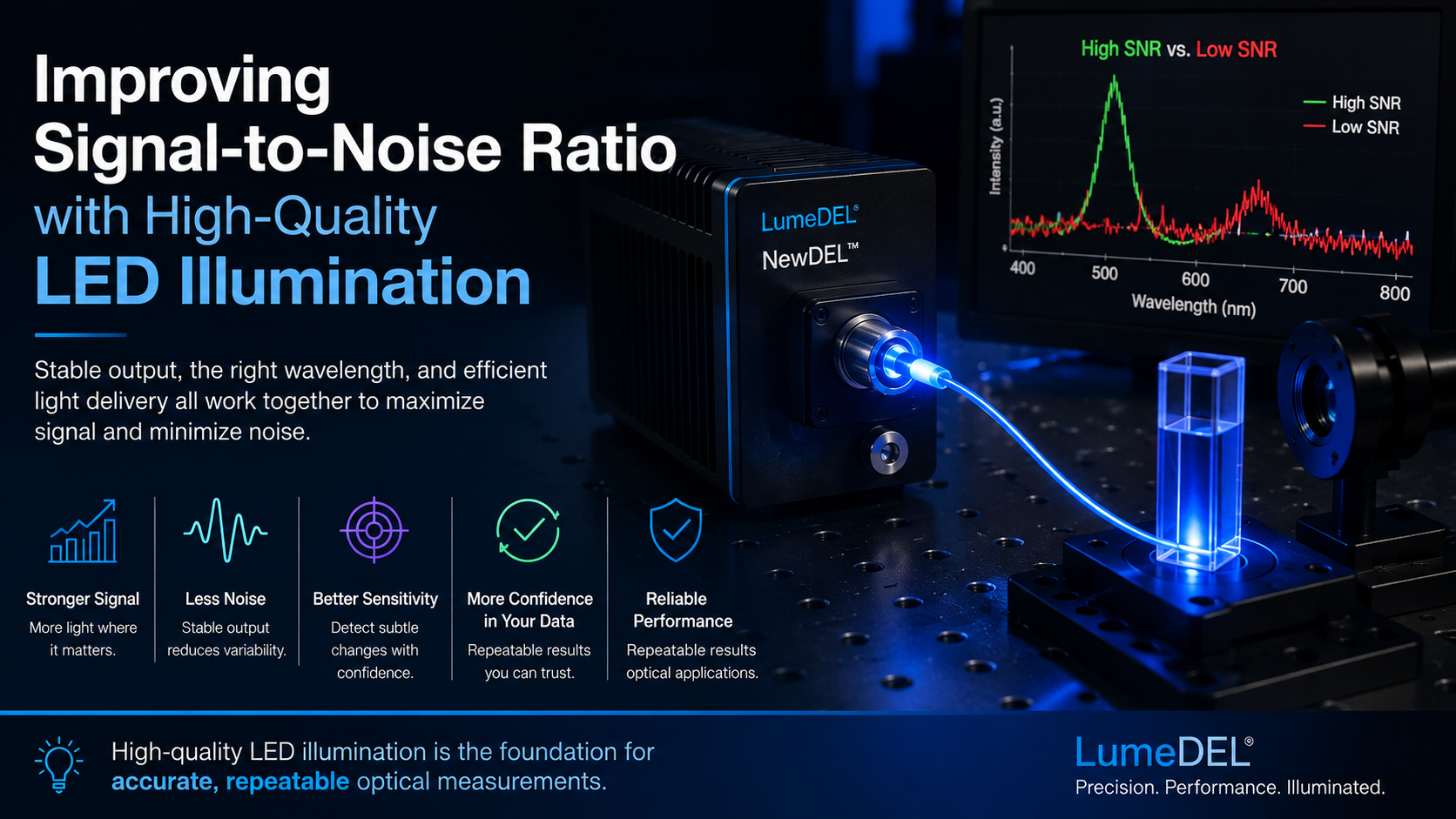
Improving Signal-to-Noise Ratio with High-Quality LED Illumination
Introduction
In optical measurement systems, generating a strong signal is only part of the challenge. The ability to distinguish meaningful optical information from background noise is equally important.
Signal-to-noise ratio (SNR) is a key measure of performance in spectroscopy, imaging, sensing, and other analytical applications. A higher signal-to-noise ratio can improve measurement sensitivity, increase confidence in collected data, and help optical systems detect smaller changes in a sample.
While detectors, electronics, and software all influence SNR, the quality and consistency of the illumination source also play an important role. Stable, efficient LED illumination can help create stronger and more repeatable optical signals while reducing variability introduced by the light source itself.
What Is Signal-to-Noise Ratio?
Signal-to-noise ratio compares the strength of the desired measurement signal with unwanted background noise.
In an optical system, noise can originate from several sources, including:
- Detector electronics
- Ambient light
- Thermal effects
- Optical losses
- Sample variability
- Fluctuations in the illumination source
When the desired signal is significantly stronger than the background noise, the system can more easily identify meaningful changes in the measurement.
Why Illumination Quality Matters
An unstable or inefficient light source can introduce variability before light even reaches the sample.
Changes in illumination intensity may appear as changes in the measured signal, making it more difficult to determine whether the variation originated from the sample or the illumination system.
A high-quality LED source provides consistent optical output, helping establish a more reliable baseline for measurement.
Stable Output Supports Reliable Measurements
Output stability is especially important during long-duration measurements or when comparing results collected at different times.
Stable LED illumination can help:
- Reduce source-related fluctuations
- Improve measurement repeatability
- Maintain consistent excitation conditions
- Reduce the need for frequent recalibration
- Increase confidence in comparative measurements
For applications that depend on detecting subtle optical changes, this consistency can be particularly valuable.
Radiant Power and Signal Strength
The amount of optical power delivered to the sample can directly affect signal strength.
When insufficient light reaches the target, the resulting signal may be difficult to distinguish from background noise. Higher radiant power can improve the available signal, provided the illumination remains appropriate for the sample, detector, and measurement method.
Applications such as spectroscopy, fluorescence measurements, and optical sensing can benefit from an illumination source capable of delivering sufficient optical power while maintaining stable performance.
The Role of Wavelength Selection
More light does not automatically mean a better signal.
The wavelength of the LED should be matched to the optical characteristics of the application. Selecting an appropriate wavelength can increase absorption, excitation, or detection efficiency while minimizing unwanted background response.
For example, proper wavelength selection can help improve:
- Fluorescence excitation
- Absorption measurements
- Chemical sensing
- Biological analysis
- Spectroscopic measurements
Combining the appropriate wavelength with stable radiant output provides a stronger foundation for high-quality optical measurements.
Fiber Coupling and Efficient Light Delivery
Optical losses between the light source and sample can also affect signal-to-noise performance.
Fiber-coupled LED systems provide a controlled method for delivering illumination from the source to the measurement location. Proper fiber selection and efficient coupling help maximize the amount of useful optical energy reaching the target.
Important considerations include:
- Fiber core diameter
- Numerical aperture
- Connector compatibility
- Coupling efficiency
- Fiber transmission characteristics
Efficient light delivery helps preserve the available optical signal throughout the system.
Applications Where SNR Matters
Spectroscopy
Higher signal-to-noise ratios can improve the ability to identify weak absorption or emission features and distinguish subtle spectral differences.
Imaging and Microscopy
Consistent illumination can improve image quality, contrast, and repeatability while helping reduce illumination-related variation.
Fluorescence
Efficient excitation and stable optical output help produce reliable fluorescence signals, particularly when emission levels are low.
Environmental and Optical Sensing
Sensors designed to detect small changes in a target sample benefit from stable illumination that minimizes source-related variability.
OEM Analytical Instruments
Instrument manufacturers require repeatable illumination performance to maintain consistent operation across measurements and devices.
LumeDEL Fiber-Coupled LED Solutions
LumeDEL’s NewDEL™ fiber-coupled LED sources provide precise, stable illumination for demanding optical and analytical applications.
Available configurations provide engineers and researchers with:
- High radiant power
- Stable and repeatable output
- Multiple wavelength options
- Efficient fiber-coupled light delivery
- Compact system integration
By combining appropriate wavelength selection, stable output, and efficient optical delivery, LED illumination can contribute to stronger, more reliable measurement signals.
Conclusion
Improving signal-to-noise ratio requires attention to the entire optical system, and illumination is an important part of that equation.
Stable output, sufficient radiant power, appropriate wavelength selection, and efficient fiber coupling can help maximize useful optical signals while reducing measurement variability.
For spectroscopy, imaging, sensing, and analytical instrumentation, high-quality LED illumination provides a reliable foundation for accurate and repeatable optical measurements.