
Introduction In optical measurement systems, generating a strong signal is only part of the challenge. The ability to distinguish meaningful optical information from background noise is equally important. Signal-to-noise ratio (SNR) is a key measure of performance in...
Why LEDs Are Replacing Traditional Lamp Technologies in Optical Systems
Introduction For decades, halogen, xenon, and mercury lamps served as the primary illumination sources for scientific instrumentation and optical analysis. Today, advances in LED technology have transformed the industry, offering higher efficiency, longer operating...
How to Choose the Right Fiber-Coupled LED Source for Your Application
Introduction Selecting the right fiber-coupled LED source is one of the most important decisions when designing an optical system. The ideal illumination solution depends on several factors, including wavelength, radiant power, fiber compatibility, stability, and the...
Selecting the Right LED Wavelength for Optical Applications
Choosing the correct LED wavelength is one of the most important decisions when designing optical and analytical systems. The wavelength of the illumination source directly affects signal strength, measurement accuracy, excitation efficiency, and overall system...
LED Stability and Repeatability: Why Consistent Output Matters
Introduction In many optical and analytical applications, illumination quality is measured not only by wavelength and radiant power but also by long-term stability and repeatability. Even minor fluctuations in light output can affect measurement accuracy, reduce...
High Radiant Power LEDs: Why Output Matters in Optical Systems
Introduction In optical systems, illumination quality is often judged by wavelength and stability. However, radiant power—the amount of optical energy delivered to a target—plays an equally critical role in determining system performance. High radiant power LEDs are...
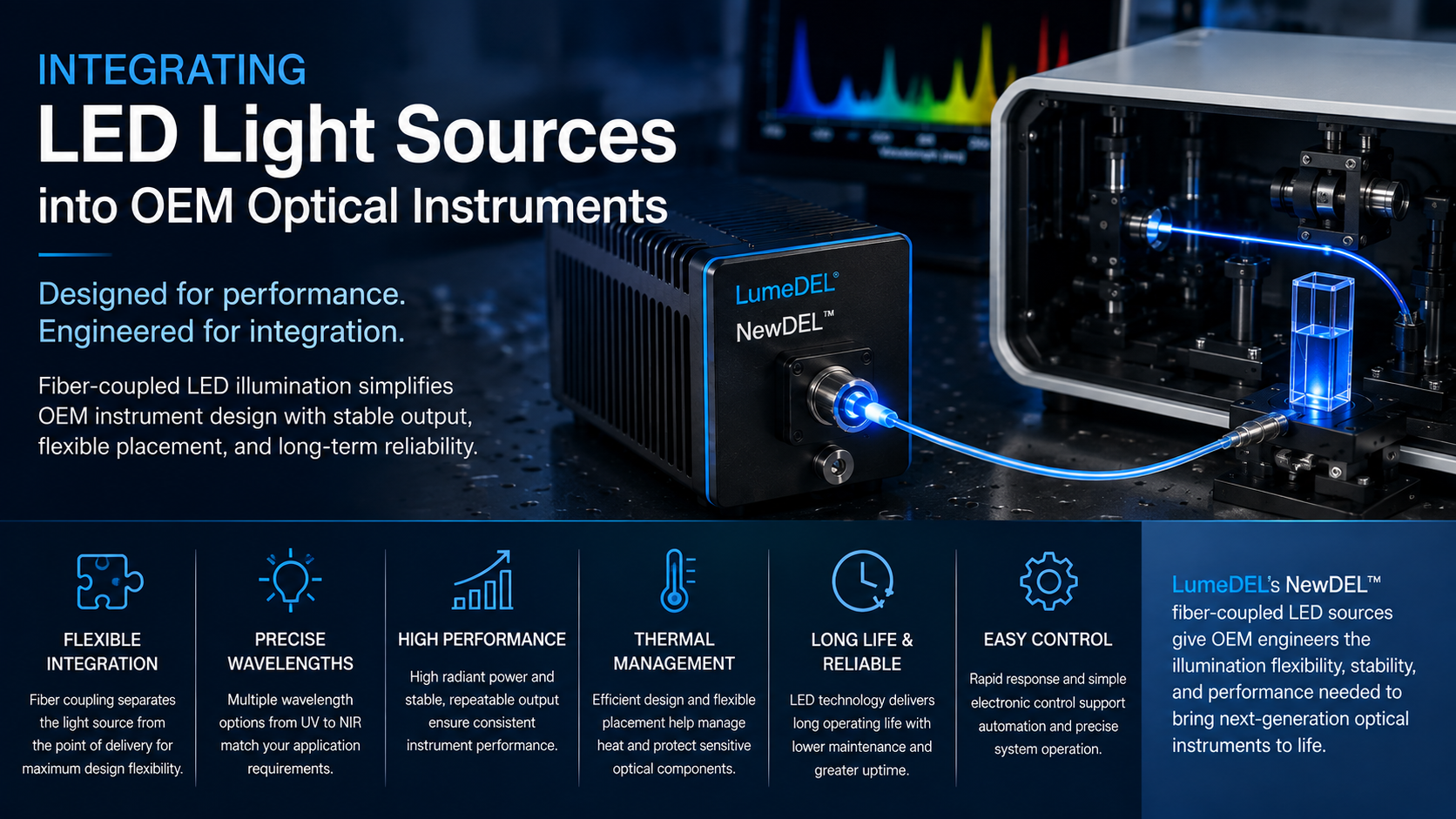
Integrating LED Light Sources into OEM Optical Instruments
Introduction
Illumination is a critical component of many OEM optical instruments. Whether a system is designed for spectroscopy, imaging, sensing, medical research, or analytical measurement, the light source must provide the required optical performance while fitting within the physical and operational requirements of the instrument.
Modern LED technology offers OEM designers an alternative to traditional lamp-based illumination with advantages that include compact size, long operating life, stable output, precise wavelength selection, and efficient control.
Fiber-coupled LED sources provide additional design flexibility by allowing the illumination source to be positioned independently from the point where light is delivered.
Start with the Optical Requirements
Successful integration begins by defining what the instrument needs from its illumination system.
Important optical considerations include:
- Required wavelength or spectral range
- Radiant power
- Output stability
- Fiber compatibility
- Illumination geometry
- Continuous or intermittent operation
Defining these requirements early helps prevent unnecessary compromises later in the design process.
Selecting the Appropriate Wavelength
OEM instruments may require a specific wavelength, multiple wavelengths, or broader spectral illumination depending on their function.
Examples include:
- UV wavelengths for fluorescence and analytical applications
- Visible wavelengths for imaging and spectroscopy
- Near-infrared wavelengths for sensing and material analysis
- Broadband illumination for applications requiring wider spectral coverage
LED technology gives designers considerable flexibility when matching illumination to the optical requirements of an instrument.
Radiant Power and Optical Efficiency
The LED source must deliver enough usable optical power to achieve the required system performance.
However, evaluating the LED itself is only part of the equation. Engineers should consider the entire optical path, including coupling losses, fiber transmission, optics, filters, and the distance between the illumination point and sample.
Efficient optical design helps ensure that sufficient radiant power reaches the target rather than being lost within the system.
Why Fiber Coupling Simplifies Integration
One of the advantages of fiber-coupled illumination is the ability to separate the light source from the optical measurement area.
Instead of designing the instrument around the physical location of an LED assembly, light can be routed through a fiberoptic patch cord to where it is needed.
This can provide several benefits:
- Greater flexibility in component placement
- Simplified optical alignment
- Easier routing through compact instruments
- Isolation of heat-producing components
- Improved accessibility for service or replacement
For OEM designers working within tight mechanical constraints, this flexibility can significantly simplify system architecture.
Stability and Repeatability
OEM instruments must perform consistently over repeated measurements and extended operating periods.
Changes in illumination output can influence calibration, measurement accuracy, and overall system reliability. Selecting an LED source with stable and repeatable output helps minimize these variables.
Consistent illumination can also help reduce recalibration requirements and improve performance across multiple production instruments.
Thermal Management Considerations
All high-performance illumination systems generate heat, and LEDs are no exception.
Effective thermal management helps maintain:
- Stable optical output
- Consistent wavelength characteristics
- LED efficiency
- Long operating life
- Overall system reliability
OEM designers should consider how the illumination source manages heat and how that thermal load interacts with other components inside the instrument.
Fiber-coupled designs can provide an additional advantage by allowing the LED source to be positioned away from thermally sensitive optical components or samples.
Control and System Operation
LEDs offer rapid response and straightforward electronic control compared with many traditional lamp technologies.
Depending on system requirements, LED illumination can support:
- Instant on/off operation
- Controlled exposure periods
- Automated measurement sequences
- Reduced warm-up requirements
- Application-specific illumination timing
These characteristics make LEDs particularly well suited for automated analytical and research instruments.
Designing for Long-Term Reliability
OEM integration involves more than achieving initial performance. Components must continue operating reliably throughout the expected service life of the instrument.
LED illumination offers several advantages for long-term system design:
- Long operating life
- Reduced maintenance
- Lower replacement frequency
- Consistent output
- Reduced power requirements compared with many traditional lamps
These benefits can contribute to lower service requirements and improved instrument uptime.
LumeDEL Solutions for OEM Integration
LumeDEL’s NewDEL™ fiber-coupled LED sources provide OEM designers with flexible illumination options for a wide range of optical and analytical instruments.
NewDEL™ systems offer:
- Multiple wavelength options
- Broadband and application-specific configurations
- High radiant power
- Stable, repeatable output
- Efficient fiber coupling
- Compact integration
- Flexible light delivery
By separating the illumination source from the point of delivery, fiber-coupled LEDs give engineers greater freedom when designing optical systems around space, thermal, and performance requirements.
Conclusion
Successful LED integration requires balancing optical performance with mechanical, thermal, and operational requirements.
Wavelength, radiant power, stability, fiber compatibility, thermal management, and component placement should all be considered during the design process.
Fiber-coupled LED technology provides OEM engineers with a flexible approach to illumination that supports compact instrument design, efficient light delivery, reliable performance, and long operating life.
For manufacturers developing the next generation of optical and analytical instrumentation, selecting the right illumination architecture can simplify integration while improving overall system performance.