
Reliable optical measurements depend on more than sensitive detectors and sophisticated analysis software. Every component in the optical path can influence the final result, including the illumination source. Calibration helps establish a known reference point so...
Integrating LED Light Sources into OEM Optical Instruments
Introduction Illumination is a critical component of many OEM optical instruments. Whether a system is designed for spectroscopy, imaging, sensing, medical research, or analytical measurement, the light source must provide the required optical performance while...
Improving Signal-to-Noise Ratio with High-Quality LED Illumination
Introduction In optical measurement systems, generating a strong signal is only part of the challenge. The ability to distinguish meaningful optical information from background noise is equally important. Signal-to-noise ratio (SNR) is a key measure of performance in...
Why LEDs Are Replacing Traditional Lamp Technologies in Optical Systems
Introduction For decades, halogen, xenon, and mercury lamps served as the primary illumination sources for scientific instrumentation and optical analysis. Today, advances in LED technology have transformed the industry, offering higher efficiency, longer operating...
How to Choose the Right Fiber-Coupled LED Source for Your Application
Introduction Selecting the right fiber-coupled LED source is one of the most important decisions when designing an optical system. The ideal illumination solution depends on several factors, including wavelength, radiant power, fiber compatibility, stability, and the...
Selecting the Right LED Wavelength for Optical Applications
Choosing the correct LED wavelength is one of the most important decisions when designing optical and analytical systems. The wavelength of the illumination source directly affects signal strength, measurement accuracy, excitation efficiency, and overall system...
Thermal Management in High-Power LED Systems
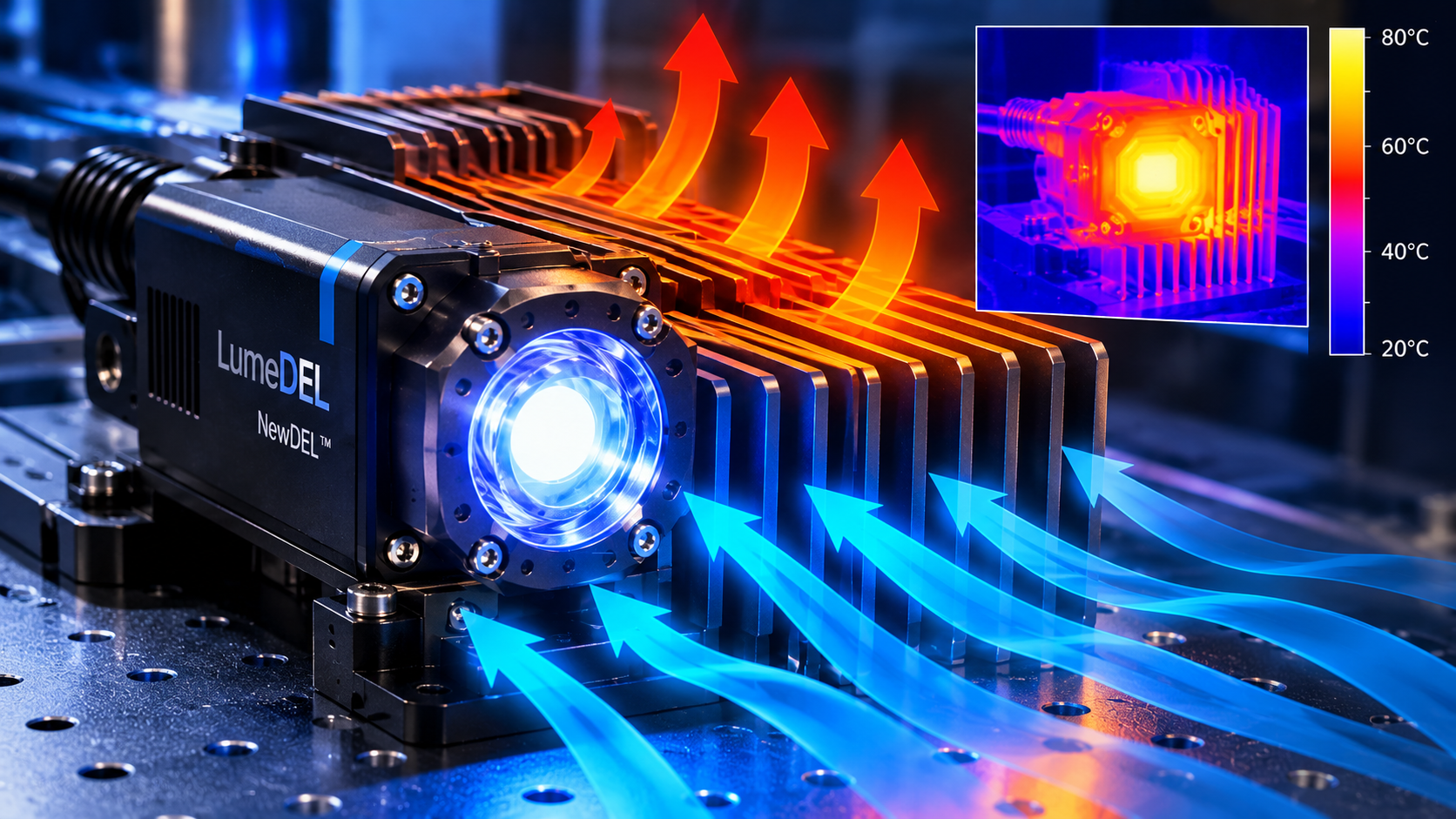
High-power LEDs provide significant advantages for scientific, industrial, and OEM optical systems, including high radiant output, precise wavelength selection, long operating life, and compact design. However, achieving consistent performance requires more than selecting an LED with the appropriate optical specifications.
As LED power increases, thermal management becomes an important part of system design.
Excess heat can affect optical output, wavelength characteristics, efficiency, stability, and component life. Effective thermal management helps an LED source maintain predictable performance throughout extended operation and demanding measurement cycles.
Why High-Power LEDs Generate Heat
LEDs are highly efficient compared with many traditional illumination technologies, but not all electrical energy supplied to an LED is converted into useful optical output.
Some energy becomes heat.
In lower-power applications, this thermal load may be relatively easy to manage. High-radiant-power systems can generate substantially more heat, making thermal design increasingly important.
Without an effective method of transferring heat away from the LED, operating temperature can rise and affect both immediate optical performance and long-term reliability.
How Temperature Can Affect LED Performance
Temperature influences several characteristics that matter in precision optical applications.
Optical Output
Changes in LED junction temperature can affect radiant output. In applications requiring consistent illumination, these variations may influence measurement accuracy and repeatability.
Wavelength Characteristics
Temperature can also influence the spectral characteristics of an LED. Applications that depend on specific wavelengths or narrow spectral regions benefit from maintaining predictable operating conditions.
Efficiency
As operating temperature increases, LED efficiency may decrease. Effective thermal management helps the source operate closer to its intended performance range.
Operating Life
Prolonged exposure to excessive temperature can accelerate component degradation. Maintaining appropriate operating temperatures contributes to longer LED life and greater system reliability.
Stability Matters in Optical Measurements
For spectroscopy, imaging, sensing, fluorescence, and other analytical applications, consistency can be just as important as maximum optical power.
If the illumination source changes as temperature increases during operation, those changes can become another variable in the measurement process.
Good thermal management helps establish a stable operating environment, supporting:
- Consistent radiant output
- Repeatable measurements
- Predictable spectral performance
- Reduced illumination-related variability
- Reliable operation during extended measurement periods
This becomes particularly important when comparing measurements collected over time.
Designing an Effective Thermal Path
Thermal management begins with efficiently moving heat away from the LED and dissipating it into the surrounding environment.
Depending on system requirements, thermal design may incorporate:
- Heat sinks
- Thermally conductive materials
- Appropriate mechanical interfaces
- Airflow or active cooling
- Temperature monitoring
- Proper spacing around heat-generating components
The appropriate approach depends on LED power, enclosure design, ambient temperature, duty cycle, and the thermal sensitivity of surrounding components.
Continuous Operation vs. Intermittent Operation
How an LED is used also affects thermal requirements.
An LED operating continuously may eventually reach a relatively stable operating temperature. Systems using rapid or intermittent illumination can experience different thermal conditions depending on power level and duty cycle.
OEM designers should consider the actual operating profile of the finished instrument rather than evaluating the LED source only under ideal laboratory conditions.
Understanding how the illumination system behaves during real-world operation helps ensure predictable performance.
Thermal Management and Fiber-Coupled LEDs
Fiber-coupled LED sources provide an additional advantage for systems containing thermally sensitive components.
Because light is delivered through an optical fiber, the LED source can often be positioned away from:
- Samples
- Detectors
- Precision optics
- Imaging systems
- Temperature-sensitive electronics
Separating the source from the point of illumination gives engineers greater flexibility when managing heat within an instrument.
This can be particularly valuable in compact OEM systems where optical performance, component placement, and thermal control must all be considered simultaneously.
Applications Where Thermal Stability Matters
Spectroscopy
Stable illumination helps maintain consistent measurement conditions during spectral analysis.
Imaging and Microscopy
Thermal control can help minimize illumination variation during extended imaging sessions.
Fluorescence Applications
Consistent excitation intensity improves repeatability when comparing fluorescence measurements.
Environmental and Optical Sensing
Long-duration sensing applications benefit from illumination sources capable of maintaining predictable output over time.
OEM Optical Instruments
Instrument designers must account for both the heat produced by the illumination source and its effect on surrounding components.
Balancing Radiant Power and Stability
Higher radiant power can provide stronger optical signals, but simply maximizing output is not always the best design strategy.
The objective is to deliver the appropriate amount of stable optical power for the application while maintaining reliable operating conditions.
This requires considering radiant output and thermal performance together rather than treating them as independent specifications.
A well-designed illumination system balances power, stability, efficiency, and component life.
LumeDEL NewDEL™ LED Sources
LumeDEL’s NewDEL™ fiber-coupled LED sources are designed to provide stable, high-performance illumination for demanding scientific, industrial, and OEM applications.
Available configurations provide:
- High radiant power
- Stable and repeatable optical output
- Multiple wavelength options
- Efficient fiber-coupled light delivery
- Flexible integration into optical systems
For applications requiring high optical performance, considering thermal behavior as part of the overall illumination design helps ensure that the source performs consistently throughout its intended operating environment.
Conclusion
Thermal management is an important consideration when designing high-power LED illumination systems.
Managing heat effectively helps maintain optical output, spectral consistency, efficiency, reliability, and operating life. It can also reduce illumination-related variability in applications where accurate and repeatable measurements are essential.
By considering thermal performance alongside wavelength, radiant power, stability, and light delivery, engineers can build LED illumination systems that provide dependable performance over the long term.