
High-power LEDs provide significant advantages for scientific, industrial, and OEM optical systems, including high radiant output, precise wavelength selection, long operating life, and compact design. However, achieving consistent performance requires more than...
Integrating LED Light Sources into OEM Optical Instruments
Introduction Illumination is a critical component of many OEM optical instruments. Whether a system is designed for spectroscopy, imaging, sensing, medical research, or analytical measurement, the light source must provide the required optical performance while...
Improving Signal-to-Noise Ratio with High-Quality LED Illumination
Introduction In optical measurement systems, generating a strong signal is only part of the challenge. The ability to distinguish meaningful optical information from background noise is equally important. Signal-to-noise ratio (SNR) is a key measure of performance in...
Why LEDs Are Replacing Traditional Lamp Technologies in Optical Systems
Introduction For decades, halogen, xenon, and mercury lamps served as the primary illumination sources for scientific instrumentation and optical analysis. Today, advances in LED technology have transformed the industry, offering higher efficiency, longer operating...
How to Choose the Right Fiber-Coupled LED Source for Your Application
Introduction Selecting the right fiber-coupled LED source is one of the most important decisions when designing an optical system. The ideal illumination solution depends on several factors, including wavelength, radiant power, fiber compatibility, stability, and the...
Selecting the Right LED Wavelength for Optical Applications
Choosing the correct LED wavelength is one of the most important decisions when designing optical and analytical systems. The wavelength of the illumination source directly affects signal strength, measurement accuracy, excitation efficiency, and overall system...
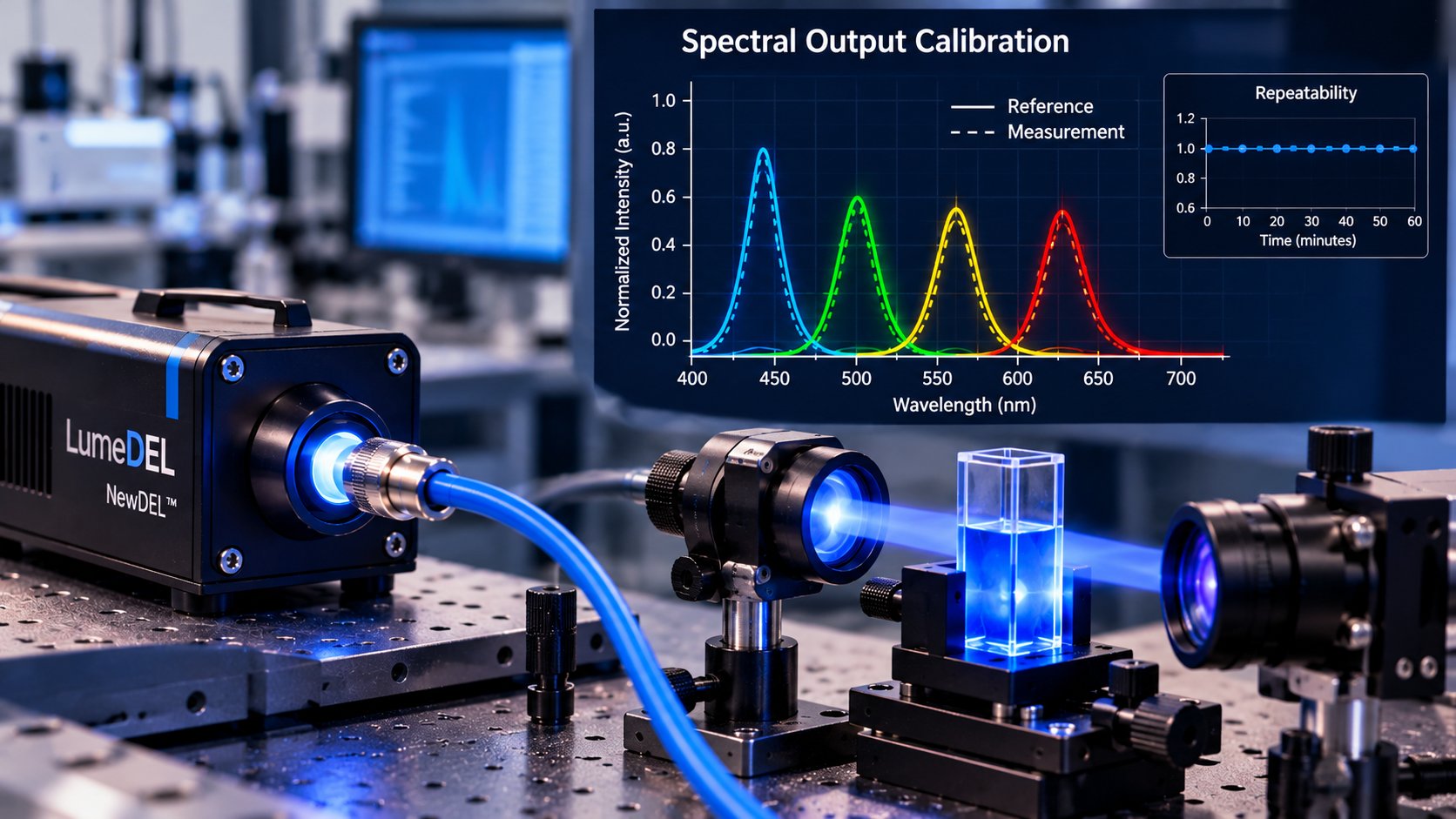
Calibrating Optical Systems for Consistent and Repeatable Measurements
Reliable optical measurements depend on more than sensitive detectors and sophisticated analysis software. Every component in the optical path can influence the final result, including the illumination source.
Calibration helps establish a known reference point so measurements collected at different times, under different conditions, or across multiple instruments can be meaningfully compared.
For spectroscopy, imaging, sensing, fluorescence, and other analytical applications, stable and repeatable illumination is an important part of maintaining calibration and measurement confidence.
Why Optical Systems Require Calibration
Optical instruments convert interactions between light and a sample into measurable information.
Over time, system behavior can change because of factors such as:
- Illumination source variation
- Detector response
- Optical alignment
- Component aging
- Temperature
- Contamination of optical surfaces
- Changes in fiber or connector performance
Calibration helps identify or compensate for these variables so the instrument continues to produce meaningful results.
The Illumination Source as Part of the Measurement System
The light source should not be viewed as separate from the measurement process.
If illumination intensity changes between measurements, the detector may record a different signal even when the sample itself has not changed.
Likewise, changes in wavelength characteristics or light-delivery efficiency can influence results.
A stable illumination source reduces one potential source of variability and provides a more consistent foundation for calibration.
Output Stability and Repeatability
Stable optical output is especially valuable when measurements are repeated over long periods.
Consider an instrument measuring the same reference sample today, next week, and several months later. For those measurements to be meaningfully compared, the system should reproduce similar operating conditions each time.
Stable LED illumination can help support:
- Consistent excitation conditions
- Repeatable reference measurements
- Reliable baseline measurements
- Long-term measurement comparisons
- Reduced source-related variability
Repeatability becomes increasingly important when an instrument is used for quality control, research studies, process monitoring, or automated analysis.
Wavelength Consistency
Many optical measurements depend on how a sample responds to specific wavelengths.
Selecting the correct LED wavelength is therefore only the first step. The illumination system should also maintain predictable spectral performance during operation.
This is particularly important in applications involving:
- Fluorescence excitation
- Absorption measurements
- Spectroscopy
- Chemical sensing
- Biological analysis
- Optical characterization
Consistent spectral output helps ensure that changes in measured response originate from the sample rather than changes in illumination.
Establishing Reference Measurements
Calibration often involves measuring a known reference and comparing subsequent measurements against that baseline.
Depending on the application, reference measurements may account for:
- Illumination intensity
- Detector response
- Background signal
- Optical transmission
- Wavelength response
- System noise
Using consistent illumination during reference and sample measurements helps improve the usefulness of that comparison.
Fiberoptic Connections Matter
In fiber-coupled systems, the optical fiber and its connections become part of the measurement path.
Changes in coupling efficiency, connector condition, fiber positioning, or fiber transmission can influence the amount of light delivered to the sample.
For consistent measurements, engineers and operators should consider:
- Fiber core diameter
- Numerical aperture
- Connector type and condition
- Fiber alignment
- Bend radius
- Transmission characteristics
Maintaining consistent fiber connections helps reduce another source of measurement variability.
Calibration and Signal-to-Noise Ratio
Calibration and signal-to-noise performance are closely related.
A system with excessive noise or unstable illumination may make it difficult to distinguish small changes in a sample from normal system variation.
Stable LED illumination can help establish a more consistent baseline, while sufficient radiant power helps generate a measurable signal above the noise floor.
Together, these characteristics support more reliable calibration and greater confidence in collected data.
Environmental Conditions
Optical systems do not always operate under identical environmental conditions.
Temperature, ambient light, vibration, humidity, and other external factors may influence measurements depending on the instrument and application.
Good calibration procedures account for relevant environmental variables and establish operating conditions that can be reproduced as consistently as possible.
Maintaining stable illumination removes one additional variable from that process.
Applications That Depend on Repeatability
Spectroscopy
Calibration helps ensure that spectral measurements remain comparable over time and across samples.
Imaging and Microscopy
Consistent illumination supports repeatable image acquisition and quantitative comparison.
Fluorescence Measurements
Stable excitation is important when comparing differences in fluorescence intensity.
Environmental Sensing
Long-term monitoring requires confidence that measured changes represent the environment rather than drift within the instrument.
OEM Analytical Instruments
Manufacturers may need consistent performance across multiple instruments, production runs, and operating locations.
Building Calibration into OEM Instrument Design
Calibration should be considered during instrument development rather than added only after the system is complete.
OEM designers can improve long-term measurement consistency by considering:
- Stable illumination
- Repeatable source control
- Optical reference standards
- Accessible calibration procedures
- Fiber and connector consistency
- Thermal management
- Automated calibration routines
Designing for calibration can simplify maintenance while improving instrument reliability throughout its service life.
LumeDEL NewDEL™ LED Sources
LumeDEL’s NewDEL™ fiber-coupled LED sources provide stable, repeatable illumination for scientific, industrial, and OEM optical systems.
NewDEL™ solutions offer:
- Stable optical output
- Multiple wavelength options
- High radiant power
- Efficient fiber coupling
- Flexible system integration
By reducing illumination-related variability, a stable LED source can provide a dependable foundation for calibrated optical measurements.
Conclusion
Calibration is essential for maintaining confidence in optical measurements, but calibration is only as reliable as the components that make up the measurement system.
Stable illumination, predictable wavelength performance, consistent fiber coupling, controlled environmental conditions, and repeatable reference procedures all contribute to measurement quality.
For spectroscopy, imaging, sensing, fluorescence, and OEM instrumentation, a stable LED illumination source helps reduce variability and supports accurate, consistent, and repeatable optical measurements over time.